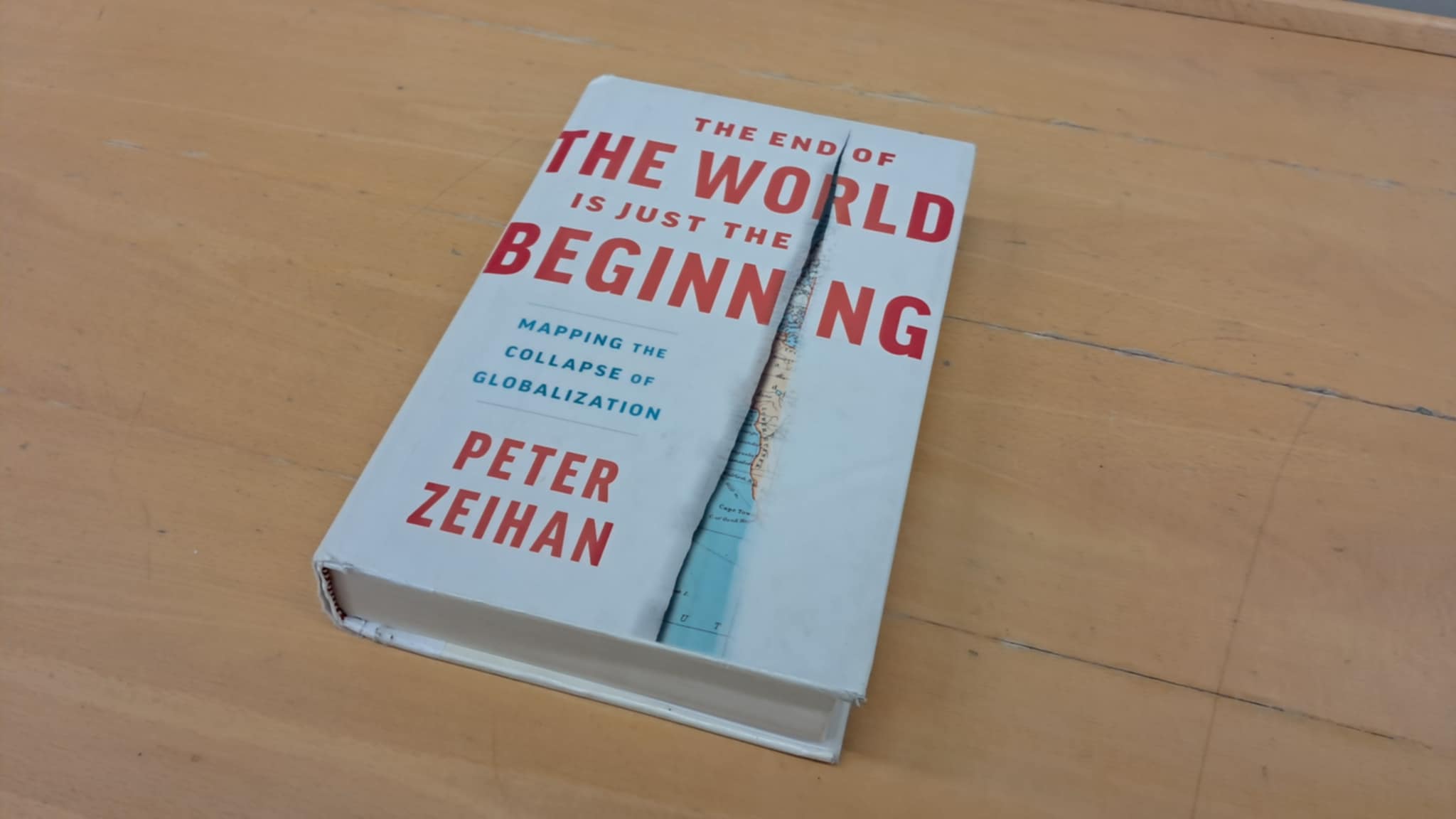
“Thirty years on from the Cold War’s end, the Americans have gone home. No one else has the military capacity to support global security, and from that, global trade. The American-led Order is giving way to Disorder” (p. 3).
Peter Zeihan’s The End of the World Is Just the Beginning: Mapping the Collapse of Globalization (Harper Business, 2022) is an ambitious and provocative exploration of the forces currently (re)shaping the global order. At the book’s core, Zeihan tackles one of the most pressing questions of our time—what happens when the post-Cold War system, largely underwritten by the United States, begins to unravel? For readers interested in geopolitics, economics, and global strategy, the book delivers a sweeping narrative that connects history, demographics, geography, and economics to make bold, consequential forecasts about the coming decades.
Zeihan’s thesis is stark. Globalization is not a naturally occurring order, he argues, but an artificial system sustained by American military and economic power. As the U.S. pulls back from the system, however, supply chains, trade networks, geopolitical alliances, and advances in world peace are fraying, leading to an unraveling of globalization and international security.
The following two sections explore Zeihan’s work in greater depth, followed by an assessment of how well his arguments have endured in light of global developments that have unfolded since the book’s publication. The concluding section offers an overall evaluation of the work, highlighting both its strengths and limitations.
The reluctant superpower: The U.S. pulls back
During the Cold War, in an effort to contain the influence of the Soviet Union and communism, the United States used its economic strength and domination of the oceans to create a system in which participants could trade freely. The Americans “fostered an environment of global security so that any partner could go anywhere, anytime, interface with anyone, in any economic manner, participate in any supply chain and access any material input—all without needing a military escort.” The result was the securing of global trade networks and the opening of new markets to participants, which Zeihan calls the “butter side of the Americans’ guns-and-butter deal” (p. 3).
The post-World War II system the U.S. sustained, though imperfect, was enormously successful. The ability to trade freely without the risk of piracy (and correspondingly high insurance costs) led to an unprecedented rise in global peace and prosperity. “During the past seven decades, as a percent of the population, fewer people have died in fewer wars and fewer occupations and fewer famines and fewer disease outbreaks than since the dawn of recorded history.” Zeihan asserts that “historically speaking, we live in an embarrassment of riches and peace” (p. 1). And that period, he argues, is coming to an end.
The U.S. withdrawal from the world order it helped to create has upended the balance. “We have been living in a perfect moment. And it is passing,” Zeihan writes. “The world of the past few decades has been the best it will ever be in our lifetime. Instead of cheap and better and faster, we’re rapidly transitioning into a world that’s pricier and worse and slower. Because our world—our world—is breaking apart” (p. 1).
Washington’s growing disengagement from the world order that it once sustained is hardly surprising, because the system lost its strategic purpose after the fall of the Soviet Union. “The post-Cold War era is possible only because of a lingering American commitment to a security paradigm that suspends geopolitical competition and subsidizes the global Order. With the Cold War security environment changed, it is a policy that no longer matches needs.” Put more bluntly—“Why expect the Americans to continue paying for an alliance when the [Cold] war was over? It would be like continuing to make mortgage payments even after your house is paid for” (pp. 40-41).
Zeihan expands on the price the United States paid to maintain the global order. “The entire concept of the Order is that the United States disadvantages itself economically in order to purchase the loyalty of a global alliance. That is what globalization is.” He argues dramatically that “the past several decades haven’t been an American Century. They’ve been an American sacrifice,” as evidenced by the U.S.’s gutted industrial heartland, a victim of the globalized world order the U.S. sustained (pp. 366-367).
The U.S. pullback from the global order has been more obvious in recent years, but the trajectory goes back to the 1990s. “When the Cold War ended,” Zeihan writes, “both on the Left and the Right, we started a lazy descent into narcissistic populism.” Lamenting the U.S.’ lack of interest in engagement with the outside world, Zeihan continues, “The presidential election record that brought us Clinton and W. Bush and Obama and Trump [twice] and Biden isn’t an aberration, but instead a pattern of active disinterest in the wider world. It is our new norm” (p. 472). Thus, even if American politicians wished to preserve the global order of the past decades, U.S. domestic politics has become increasingly incapable of producing leaders committed to maintaining a costly international system that economically disadvantages the homeland.
“So this is how it all falls apart”
Zeihan devotes much of his book to analyzing and mapping the emerging post-U.S. global (dis)order, and his outlook is pessimistic. In a world no longer bound by the ties of U.S.-sustained globalization, fragile and unreliable intercontinental supply chains will increasingly force countries to produce their own food, energy, and industrial goods. “The 2020s will see a collapse of consumption and production and investment and trade almost everywhere,” Zeihan predicts. “Globalization will shatter into pieces. Some regional. Some national. Some smaller. It will be costly. It will make life slower. And above all, worse” (pp. 3-4).
Demographic decline, driven by both aging populations and declining birth rates, is central to Zeihan’s forecast. As globalization led to increased urbanization, rural populations moved to urban areas and average family sizes shrank. “In 2019, the Earth for the first time in history had more people aged sixty-five and over than five and under. By 2030 there will be twice as many retirees, in relative terms” (p. 73). He shows how shrinking workforces and retired populations will drive economic contraction and social strain, especially in Europe, East Asia, and China.
Zeihan stresses that geography, internal cohesion, and resource access will determine winners and losers. Countries like the United States, with secure borders, arable land, abundant energy resources, and demographic stability, are advantaged and best positioned to maintain stability and prosperity. Countries with industrial capacity and advantaged by proximity to regional powers, such as Mexico to the United States, may also prosper. Others may emerge as regional hegemons, such as Nigeria with its significant natural resources and arable land, or India with its favorable demographics and growing energy capacity.
The future of other regions is less bright. Europe faces demographic decline, energy dependence, and limited geographic flexibility. “The Europeans, in the most peaceful and wealthy period in their history, have proven incapable of coming together for a common cheese policy, a common banking policy, a common foreign policy, or a common refugee policy—much less a common strategic policy. Without globalization, nearly three generations of achievement will boil away” (p. 472). Zeihan predicts increasing fragmentation with countries pursuing stronger bilateral relations, such as cooperation among the Nordic states, rather than relying on the EU or global systems.
The Middle East will become increasingly vulnerable due to the region’s dependence on U.S.-backed security and global trade networks. Even among the oil-rich Gulf states, limited domestic food and water production, geographic constraints, and reliance on maritime trade all pose risks. Conflict-prone areas such as Syria and Yemen highlight the limits of local stability and governance in a fragmented global order.
Zeihan reserves his harshest criticism for Russia and China. Like other countries, both face demographic decline, resource dependencies, and internal governance challenges that will amplify the effects of deglobalization. Moreover, Russia, despite its resource wealth, faces vast distances and harsh climates that complicate internal logistics and defense. However, although both countries have benefited immensely from an American-led order that quieted historical enemies and fostered economic stability, they have “fallen back on instinct” and have “worked diligently—almost pathologically—to disrupt what remained of global structures” (p. 472). In doing so, their policies have accelerated the disintegration of the postwar global order.
Nor is the disastrous unraveling of globalization likely to compel the United States to reengage with the international order it once sustained, thus leaving the world less secure. “If the global superpower were involved, at least there would be some rules,” Zeihan writes. “Instead we will have erratic intra-regional competitions in which the Americans will largely decline participation. Erratic competition means erratic materials access, which means erratic technological application, which means erratic economic capacity” (p. 320). Zeihan concludes on a bleak note. “Nor is there leadership beyond America. There is no new hegemon-in-waiting, nor countries that will rise to support a common vision. There is no savior waiting in the wings” (p. 472). With no one both willing and able to sustain the postwar global order, the messy fragmentation of globalization is inevitable.
Assessing Zeihan’s Forecasts in Light of Recent Events
Global events since the book’s publication in 2022 have validated many of Zeihan’s predictions and warnings. His central thesis of a fraying global order previously underwritten by an increasingly uninterested United States is still highly relevant, although Washington has not lost interest totally. Trends, crises, and shifts in the international landscape from 2022 to present (October 2025 at the time of writing) underscore both the fragility of this system and the uneven ways countries are responding.
Supply chains and trade illustrate his point clearly. Global supply networks remain vulnerable to disruption despite significant investments in resilience and diversification. Firms have pursued nearshoring, friend-shoring, “China+1” strategies, and digital risk management. Nevertheless, geopolitical tensions, regulatory shifts, and climate risks continue to strain the system.
Europe’s energy and strategic exposure have also borne out Zeihan’s warnings. The 2022 Russian invasion of Ukraine precipitated—among other crises—a severe gas crisis that exposed Europe’s dependence on external energy sources as well as its ill-advised overreliance on Russian suppliers. Governments responded rapidly by pivoting to alternative LNG suppliers (such as the US, Algeria, and Qatar), boosting storage, and accelerating renewable initiatives. However, the shock confirmed the region’s vulnerability and the costs of overreliance on unreliable external partners.
Demographics, particularly in China and developed economies, remain a decisive structural factor. China’s population declined for the third consecutive year in 2024, while birthrates in Japan, South Korea, and parts of Europe continue to fall. These trends lend credence to Zeihan’s contention that shrinking workforces and aging societies will constrain production, consumption, and long-term economic growth. Although he does not address that migration may alleviate many of these concerns, Zeihan’s assertion that demographics are an underappreciated determinant of national fortunes still holds true.
American disengagement would trigger widespread global disorder in Zeihan’s predictions, but the reality thus far has been more mixed. Instead of complete withdrawal, the U.S. has alternated between selective engagement (e.g., supporting Ukraine and maintaining Indo-Pacific deterrence) and domestic retrenchment (e.g., withdrawal from the Paris Agreement and the introduction of tariffs). Nevertheless, regional conflicts, trade disruptions, and uncertainty now shape global dynamics more without the United States as a dependable guarantor. The global order has not collapsed into mass disorder but rather the “erratic competition” that Zeihan anticipated as a likely outcome.
Midway through the 2020s, Zeihan’s forecasts have proven insightful and prescient overall. Supply-chain fragility, European energy vulnerability, demographic decline, and the limits of the post-U.S. security architecture are clear features of the present global order. However, adaptations such as policy responses, partial nearshoring, selective U.S. engagement, and market adjustments have mitigated the immediate impacts of the decline of globalization. The result is a world that is more unstable and complex, but not (yet) at the full-scale breakdown that Zeihan envisioned.
Final Assessment: A Critical Evaluation of The End of the World Is Just the Beginning by Peter Zeihan
The End of the World Is Just the Beginning is an insightful, provocative analysis of globalization’s unraveling. Zeihan challenges readers to confront the fragility of the postwar world order and consider trends that will shape the coming decades. Its innovative framework provides macro-level insights that encourage long-term strategic thinking about demographics, geography, and economics. The book is entertaining and accessible to non-experts, which is refreshing (and even necessary) in a volume of its size.
Yet some criticism remains. A work entitled The End of the World can be forgiven for its pessimism, but Zeihan often presents bleak speculative scenarios as inevitable. Human agency is underestimated, minimizing the possibilities of social and political adaptability or technological innovation; and such agency is depicted as reactive rather than proactive. Moreover, Zeihan analyzes the global order through a U.S.-centric lens, often underplaying the nuances of non-U.S. regions—perhaps too complex a topic in an already-extended volume. Finally, for all the challenges and unpleasantness of the past years, the world has (so far at least) not seen the level of collapse Zeihan predicted in the decade.
Even if one disagrees with Zeihan on certain conclusions, his book nevertheless succeeds in clarifying why globalization may not be permanent, why some countries will be advantaged in the post-U.S. order, and how shifts in demographics, geography, and global security will reshape our world. For readers interested in the future of global politics and economics, this book is essential and pairs well with works by Ian Bremmer, Anne Applebaum, and other geopolitical analysts.