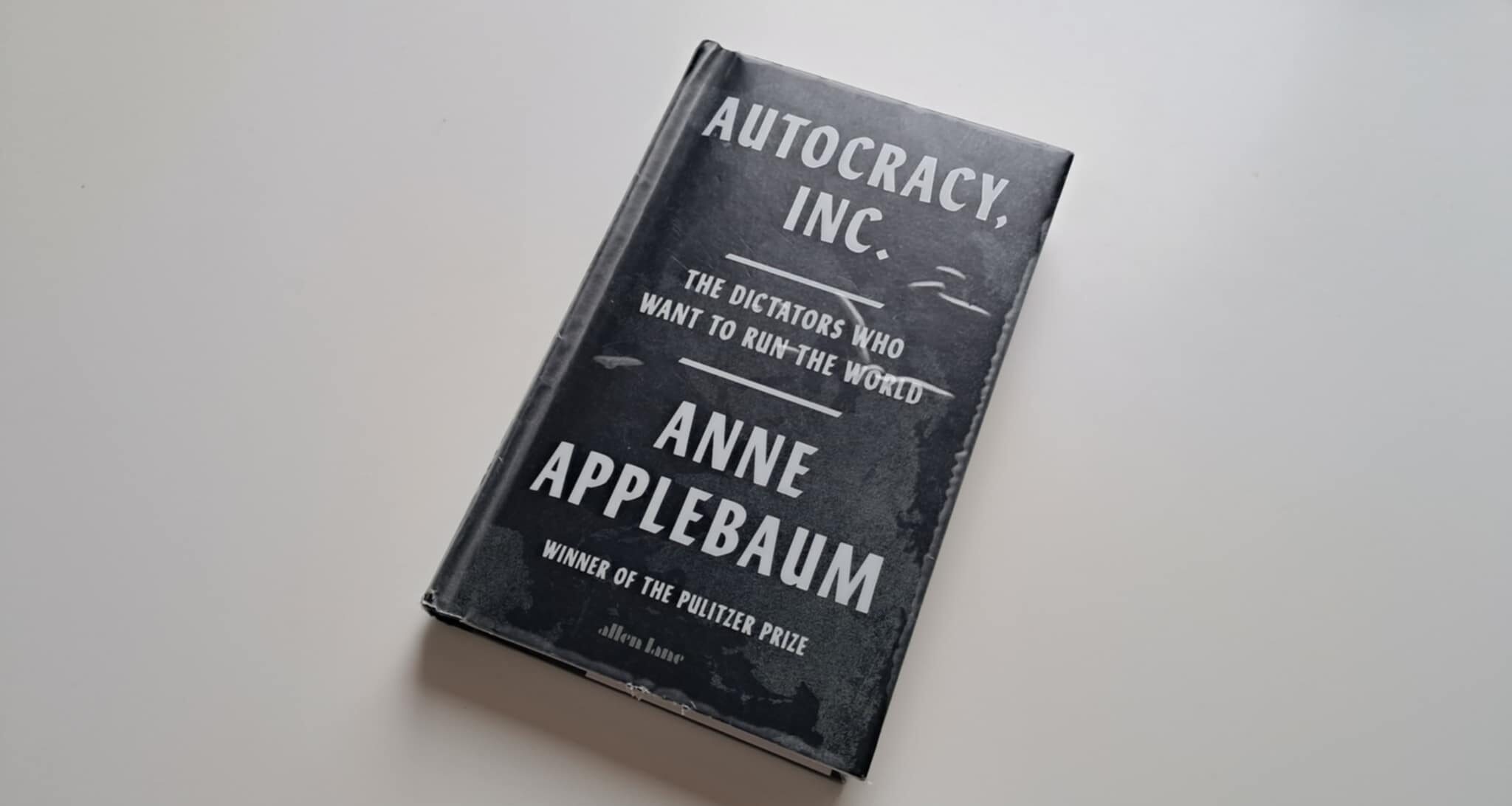
In Autocracy, Inc.: The Dictators Who Want to Run the World (Allen Lane, 2024), journalist and historian Anne Applebaum offers a timely and wide-ranging analysis of how 21st-century autocracies operate in an increasingly interconnected global environment. Building on themes from Twilight of Democracy (2020) and her extensive reporting on modern authoritarianism, she argues that today’s strongmen are linked not by rigid ideology, but by shared interests of wealth, personal power, and mutual protection. She also challenges democracies to confront their own vulnerabilities and to reconsider how they defend freedom in a shifting global order where longstanding assumptions no longer hold. The four sections that follow examine Applebaum’s work in greater depth, followed by an examination of recent global developments in the context of her arguments.
Autocracy, Inc.: A Corporate Model of Autocratic Rule
At the heart of Applebaum’s analysis is the concept of Autocracy, Inc., a loose alliance of autocratic actors whose cooperation sustains their respective regimes. The system functions somewhat like a corporation, with fluid, transactional, and profit-driven goals. Its members benefit from one another’s resources and exploit loopholes and institutions within democratic societies as well. Through elite networks that cross national borders, autocrats use global markets to conceal assets, launder reputations, and manipulate narratives. Applebaum writes, “Nowadays, autocracies are run not by one bad guy but by sophisticated networks relying on kleptocratic financial structures, a complex of security services—military, paramilitary, police—and technological experts who provide surveillance, propaganda, and disinformation” (pp. 1-2).
Unlike the ideological blocs of the Cold War, members of Autocracy, Inc., pursue more self-serving and opportunistic policies. “Their bonds with one another, and with their friends in the democratic world, are cemented not through ideals but through deals—deals designed to take the edge off sanctions, to exchange surveillance technology, to help one another get rich” (p. 3). Moreover, unlike in the Cold War, when ideology and party machines curbed overt corruption, leaders in Autocracy, Inc., openly flaunt their opulent lifestyles and maintain personal for-profit ventures through which clients can purchase political favors.
The leaders of Autocracy, Inc., share a common enemy in the forces that would check their corruption and personal power. “That enemy is the democratic world, ‘the West,’ NATO, the European Union, their own, internal democratic opponents, and the liberal ideas that inspire all of them.” Ideas that threaten the machine of Autocracy, Inc., include “the notion that the law is a neutral force, not subject to the whims of politics; that courts and judges should be independent; that political opposition is legitimate; that the rights to speech and assembly can be guaranteed; and that there can be independent journalists and writers and thinkers who are capable of being critical of the ruling party or leader while at the same time remaining loyal to the state.” Applebaum expands, “If judges and juries are independent, then they can hold rulers to account. If there is a genuinely free press, journalists can expose high-level theft and corruption. If the political system empowers citizens to influence the government, then citizens can eventually change the regime” (p. 10). Thus, autocratic rulers have strong incentive to undermine these ideas.
To suppress opposition and push back against liberal ideas that may threaten their power, the member of Autocracy, Inc., “share a determination to deprive their citizens of any real influence or public voice, to push back against all forms of transparency or accountability, and to repress anyone, at home or abroad, who challenges them” (p. 3). Applebaum underscores that contemporary autocrats have abandoned even the pretense of legitimacy. “Today, the members of Autocracy, Inc., no longer care if they or their countries are criticized or by whom. Some…don’t stand for anything beyond self-enrichment and the desire to remain in power, and so can’t be embarrassed.” Because they are “impervious to international criticism,” she argues, “modern autocrats feel no shame about the use of open brutality” (p. 6).
Members of Autocracy, Inc., also intervene directly in one another’s countries to protect the global system of autocracy, such as the Russian interventions in Syria and Belarus. Applebaum describes what she calls “a regime survival package…[that] can include personal protection for the dictator; violent assaults on his political enemies; help in fighting an insurgency; broadcast or social media campaigns that echo the themes of multipolarity and anticolonialism; kleptocratic contacts that help the elite hide money.” As part of the bargain, “the local dictator will also be cut off from democratic allies, either because the violence and repression needed to maintain power make him too unpalatable or because his new…allies insist he cut ties with old American and European friends” (p. 120). By thus supporting each other, autocrats collectively reshape the global balance in favor of authoritarian governance.
To deepen understanding of Autocracy, Inc., Applebaum challenges the assumptions of the foreign policy realism espoused by John Mearsheimer and others, arguing that the hostility of autocratic regimes toward democracies cannot be reduced to mere geopolitical competition. As she writes, their opposition “has its roots in the very nature of the democratic political system, in words like ‘accountability,’ ‘transparency,’ and ‘democracy.’ They hear that language coming from the democratic world, they hear the same language coming from their own dissidents, and they seek to destroy them both” (pp. 10-11). Autocrats understand that concepts such as transparency, justice, and democratic participation will always resonate with parts of their own populations, which is precisely why “they must undermine those ideas, wherever they are found” (p. 13). Realism, she suggests trenchantly, offers a dangerous complacency by “appeal[ing] to the indifferent. If nations never change, then of course we don’t need to exert the effort to make them change. If nations have permanent orientations, then all we need to do is discover what those are and get used to them” (p. 175).
Such misplaced ideology and complacency are not confined to geopolitical theorists. Western governments also adopted policies that consistently underestimated autocratic ambition, most notably the post-Cold War belief that autocracies would liberalize through open markets and economic engagement. In doing so, they helped incorporate these regimes into global institutions and markets, often deepening the very vulnerabilities they failed to anticipate.
International Corruption: The West’s Complicity
Western democracies help to sustain authoritarianism, as the openness that once enabled democratic expansion now provides the same operating environment for authoritarian networks. Law firms, real-estate markets, and financial centers in London, New York, and Zurich have become conduits for kleptocratic wealth. Shell companies and reputation laundering help autocrats secure both their fortunes and their international legitimacy. The result is not convergence toward democracy, but the quiet normalization of autocratic behavior within democratic societies themselves.
Influential in the West’s decision-making processes was Francis Fukuyama’s End of History and the Last Man (1992), which posited the inevitable spread of liberal democracy and market capitalism. That confidence, she argues, encouraged Western leaders and investors to welcome autocratic states into their institutions and markets without proper due diligence, unintentionally helping lay the groundwork for Autocracy, Inc. “The idea that there was something pre-ordained, even inevitable, about liberal democracy had a deep appeal. It made the inhabitants of democracies feel virtuous, since they already lived in the ideal society. It made the businessmen and bankers who were just then beginning to expand their investments into China and the post-Soviet world feel better too.” After all, she continues, “if the old moral dilemmas about investing in autocracy were gone, then there was nothing special they needed to do to justify their actions” (pp. 23-24). The myth of Wandel durch Handel—the belief that autocracies would liberalize through economic engagement—became so deeply embedded in the German political establishment that, after the country’s reunification, the American security umbrella that had made that reunification possible was scarcely acknowledged in some official commemorations.
Controlling the Narrative: The Digital Dimension
One of the book’s most compelling sections examines how technology has reshaped authoritarian power, showing that digital interconnectedness has become autocracy’s greatest advantage. Whereas Cold War regimes relied on censorship and physical surveillance, today’s autocrats thrive in the openness of the digital age, weaponizing social media, data analytics, and cyber operations to manipulate information and sow distrust. Moreover, Applebaum describes how spyware, online troll networks, and AI-enabled surveillance technologies now circulate freely across borders, creating a hybrid information ecosystem in which authoritarian narratives proliferate with ease while democratic discourse fragments.
Autocracy, Inc., has gone on the digital offensive, using their resources to undermine democracy and democratic institutions. Applebaum writes, “If people are naturally drawn to the image of human rights, to the language of democracy, to the dream of freedom, then those ideas have to be poisoned. That requires not just surveillance, and not merely a political system that defends against liberal ideas. It also requires an offensive plan, a narrative that damages the idea of democracy, wherever it is being used, anywhere in the world” (p. 73). The result is an information environment in which democratic ideals must constantly compete with narratives designed to discredit them and make them seem unworkable.
The information strategy employed by modern autocracies is not designed to persuade audiences that their system is superior or offers a brighter future, but rather to convince them that the alternatives are worse. As Applebaum notes, “They don’t offer their fellow citizens a vision of utopia, and they don’t inspire them to build a better world. Instead, they teach people to be cynical and passive, because there is no better world to build. Their goal is to persuade people to mind their own business, stay out of politics, and never hope for a democratic alternative.” This messaging reinforces the sense that corruption is universal even in the democratic world and that meaningful reform is impossible, thus increasing fatalism and reducing political engagement. Applebaum summarizes the autocratic line: “Our state may be corrupt, but everyone else is corrupt too. You may not like our leader, but the others are worse. You may not like our society, but at least we are strong and the democratic world is weak, degenerate, divided, dying” (p. 74).
One specific strategy is the so-called “fire hose of falsehoods,” when audiences are bombarded with enormous amounts of contradictory information and often-ludicrous theories. The goal is not to convince the audience to believe something false, but rather to muddy the information space such that the truth seems impossible to discern, thus creating cynicism and nihilism. Applebaum explains, “Given so many explanations, how can you know what actually happened? What if you can never know? If you can’t understand what is going on around you, then you are not going to join a great movement for democracy, or follow a truth-telling leader, or listen when anyone speaks about positive political change. Instead, you will avoid politics altogether” (p. 79).
Autocrats use these information strategies to undermine democracy not only at home but also around the world by exaggerating popular anger and political divides. “They pay or promote the most extreme voices, hoping to make them more extreme, and perhaps more violent; they hope to encourage people to question the state, to doubt authority, and eventually to question democracy itself” (p. 96-97). The agent of division can be anywhere on the political spectrum. “In seeking to create chaos, these new propagandists, like their leaders, will reach for whatever ideology, whatever technology, and whatever emotions might be useful. The vehicle of disruption can be right-wing, left-wing, separatist, or nationalist, even taking the form of medical conspiracies or moral panic” (p. 97). In the United States, for example, autocratic regimes may promote (or even invent) left-wing voices pushing social justice narratives while simultaneously amplifying right-wing figures peddling fringe conspiracy theories, exploiting the full political spectrum to sow division and confusion.
At its most brazen, this information strategy becomes a demonstration of power, such as when a once-respected individual suddenly begins repeating obvious lies and conspiracy theories. This serves both as a loyalty test to the regime and a message to potentially troublesome elements. Personal corruption and stealing from the state is acceptable if you are loyal to the regime, while the consequences of disloyalty can be severe. Bluntly stated, “sometimes the point isn’t to make people believe a lie; it’s to make people fear the liar” (p. 78). The spectacle is not meant to persuade, but to intimidate.
Democrats United: Resistance and Resilience
Applebaum concludes with a series of recommendations for countering Autocracy, Inc. Just as the democratic world coordinated its efforts during the Cold War to undermine international communism, so too can modern democracies form a similar front to counter the new networks of autocratic cooperation. She argues for the creation of a project of Democrats United—an international “anti-kleptocratic network” designed “to change the laws, end secretive practices, and restore transparency to the international financial system” (pp. 161-162).
In the information sphere, she urges democracies not merely to respond to autocratic narratives, but to proactively weaken and undermine them. This requires recognizing and confronting “an epidemic of information laundering and…exposing it when we can” through measures such as the State Department’s Global Engagement Center, pre-bunking techniques, and ending practices like typosquatting (p. 164). Moreover, information resilience depends not only on new tools, but also on new laws, rules, and regulations. Through such measures, “transparency can replace obscurity” (p. 166).
To counter the narratives of Autocracy, Inc., democracies must go on the offensive and promote the virtues of their own institutions. “No democratic government should ever assume that arguments for democracy or for the rule of law are somehow obvious or self-evident,” Applebaum writes. “Authoritarian narratives are designed to undermine the innate appeal of those ideas, to characterize dictatorship as stable and democracy as chaotic.” However, “democratic media, civic organizations, and politicians [can] argue back and make the case for transparency, accountability, and liberty—at home and around the world” (pp. 166-167). Furthermore, citizens of democratic societies can play a powerful role in shaping public discourse, and democratic governments can equip them to do so by ensuring they can control their own data, influence algorithms, and go on the offensive. A joint democratic effort, moreover, would help those living in autocracies better understand the global context of their own regimes.
Because autocrats cannot easily impose traditional censorship, they instead focus on winning audiences by “channeling resentment, hatred, and the desire for superiority.” Democracies must therefore “learn to compete while preserving and promoting our own values. That means breaking the autocrats’ monopoly on the use of strong emotions [and] connecting to audiences with the issues that concern them the most.” Crucially, audiences must see that positive change is indeed possible. “Good information has to help bring positive change. Truth has to be seen to lead to justice” (pp. 167-168).
Alongside informational reform, democracies must confront the deep economic entanglements that have enabled autocratic power to flourish. Applebaum warns, “The risks of overdependence on trade with Russia, China, or other autocracies aren’t just economic. They are existential” (p. 170). Besides strengthening and creating dependency on autocratic regimes, today’s supply-chain vulnerabilities, such as exposure to autocratic states for minerals, semiconductors, and energy, also corrupt democratic societies. Western politicians and elites have become enmeshed in these systems, often enriching themselves from the very networks that undermine democratic norms. “Some of the wealthiest and most powerful Americans and Europeans are themselves playing ambivalent roles in these trades,” she writes. “We no longer live in a world where the very wealthy can do business with autocratic regimes, while at the same time doing business with the American government, or with European governments, and enjoying the status and privileges of citizenship and legal protection in the free markets of the democratic world.” Her solution is simple—”It’s time to make them choose” (p. 173).
Applebaum concludes her book with an appeal to democratic societies around the world to protect and promote their way of life amid the changing world order. “There is no liberal world order anymore, and the aspiration to create one no longer seems real,” she writes. “But there are liberal societies, open and free countries that offer a better chance for people to live useful lives than closed dictatorships do…. They can be destroyed from the outside and from the inside, too, by division and demagogues. Or they can be saved. But only if those of us who live in them are willing to make the effort to save them” (pp. 175-176). Citizen engagement is crucial in combatting cynicism, misinformation, and corruption, for democracy dies not in darkness, but in apathy.
Autocracy, Inc. Revisited: Evaluating Applebaum’s Analysis amid Current Events
Since the publication of Autocracy, Inc., a number of high-profile financial and political developments have underscored the continued relevance of Applebaum’s warnings. Recent policy shifts in the United States under President Trump illustrate how some of the institutions she identifies as vital, particularly those supporting financial transparency and information resilience, are under significant pressure. These events suggest that the effectiveness of legitimate democratic systems relies on both established structures and the application of processes that support accountability and transparency.
In the area of financial transparency, for example, the U.S. Treasury has narrowed the scope of beneficial-ownership reporting. A March 2025 rule exempts U.S. companies and citizens from disclosing their beneficial owners to FinCEN, substantially reducing the reach of the Corporate Transparency Act. Critics argue that this change may weaken safeguards designed to detect illicit finance and clarify obscure corporate structures.
The administration has also altered federal infrastructure responsible for responding to foreign information operations. In April 2025, the State Department closed its Counter Foreign Information Manipulation and Interference office, which was a successor to the Global Engagement Center, which Applebaum argued should be strengthened. Although the administration states that the goal is to reduce what it perceives as government overreach in monitoring speech, analysts warn that the practical effect may be to leave the United States less prepared to identify and counter coordinated international disinformation efforts.
The emergence of the Trump-linked stablecoin USD1 has raised red flags. Given the Trump family’s stake in World Liberty Financial (WLF), the issuer of the stablecoin—which is used in multibillion-dollar transactions and backed by interest-generating assets—they could potentially gain tens of millions of dollars annually from USD1, creating a long-term, opaque revenue stream potentially tied to both political influence and global financial flows. In one deal, Abu Dhabi’s sovereign-backed MGX fund used USD1 to settle a $2 billion investment in Binance. Observers have also noted USD1’s integration with the Tron blockchain and connections to crypto figures like Justin Sun, raising concerns about the influence of powerful actors in shaping financial flows. Meanwhile, the launch of meme coins such as $TRUMP illustrates how political figures can monetize public profile and influence, potentially turning digital assets into vehicles for personal wealth accumulation and global bargaining.
Foreign influence efforts have also raised concerns. Qatar’s recent gift to President Trump of a $400 million Boeing 747-8 jumbo jet triggered bipartisan scrutiny over ethics, national security, and constitutional questions. The Pentagon accepted the aircraft and plans to retrofit it at taxpayer expense for potential use as a presidential plane, after which it may be transferred to Trump’s presidential library foundation. Critics argue that accepting such a gift from a foreign state risks violating constitutional constraints, notably the Emoluments Clause, and raises broader concerns about foreign influence; meanwhile, Qatar maintains that the gift is a routine gesture between allies. Nevertheless, this episode demonstrates how autocratic and illiberal regimes can insert themselves into democratic institutions through symbolic and material gifts, blurring the lines between diplomatic statecraft and private benefit.
Trump’s use of the presidential pardon—a constitutional authority that many presidents including Bill Clinton and Joe Biden have used controversially—illustrates how clemency may operate as a mechanism for rewarding political allies or reinforcing personal networks of influence, raising concerns about its impact on the rule of law. In addition to issuing a blanket pardon to January 6 participants, even those who engaged in violent acts, Trump has granted clemency to individuals with notable financial or personal connections. Examples include Trevor Milton, founder of Nikola, who donated over $1.8 million to Trump’s campaign; Changpeng “CZ” Zhao, founder of Binance, whose exchange was financially entangled with Trump’s WLF and USD1 stablecoin; and Paul Walczak, whose mother contributed $1 million to a Trump fundraising event shortly before his pardon. Critics have cited these as examples of how clemency can be used to reward loyalty, shield allies from legal jeopardy, and reinforce political, personal, and financial networks of influence within and across borders.
On the broader autocratic wealth front, recent reporting has continued to examine how political elites and their networks may use complex financial arrangements to manage assets abroad. The Dubai Unlocked (2024) investigation, for example, identified substantial property holdings in Dubai linked to politically exposed persons from Russia, Africa, and the Middle East, often recorded through intermediaries or corporate structures. Inclusion in the data does not constitute evidence of guilt, just as an abnormally high number of foreign clients in real estate transactions or hotel reservations does not prove wrongdoing. However, the patterns uncovered highlight structural features of the global financial ecosystem that Applebaum argues must be addressed, such as limited transparency, inconsistent disclosure rules, and uneven enforcement.
Recent developments in Europe similarly illustrate some of the vulnerabilities Applebaum highlights. In Germany, investigations involving lawmakers and former MEPs have reported alleged acceptance of foreign funds and possible influence operations. The 2025 EU-wide Huawei bribery probe suggested attempts to influence MEP decisions through consultancy fees and gifts. In France, former president Nicolas Sarkozy was convicted in September 2025 of criminal conspiracy in a case involving alleged funding from Libya for his 2007 campaign, highlighting the vulnerabilities that cross‑border financial influence can pose for democratic governance. Similarly, in the UK-EU context, former British MEP Nathan Gill was convicted in November 2025 for reportedly accepting funds from a pro-Kremlin actor in exchange for promoting pro-Russian narratives. Collectively, these instances demonstrate that gaps in transparency and accountability can allow foreign actors to seek influence across European institutions, underscoring the importance of cross-border oversight, beneficial-ownership transparency, and institutional safeguards.
Conclusion: Understanding the Global Authoritarian Network
Autocracy, Inc. offers a clear account of how today’s autocrats build and maintain power, framing modern autocracy as a globalized and networked business model often enabled by financial, legal, and informational infrastructure within democratic systems. Applebaum’s assessment of the 21st-century authoritarian resurgence is made even more relevant by the growing visibility of disinformation, corruption, and institutional capture within democracies themselves. Her analysis underscores the need for coordinated democratic responses that address both external pressures and internal vulnerabilities.
For readers interested in geopolitics, democratic resilience, and the forces shaping the global landscape, Autocracy, Inc. offers both a framework for analysis and a challenge to defend and strengthen democracy. As the liberal order weakens and power becomes increasingly transactional, Applebaum provides insight not only into where global politics may be headed, but also into how democracies can adapt to a world shaped by networks that transcend borders. Her book is essential for readers interested in the future of global politics and pairs well with works by Ian Bremmer, Peter Zeihan, and other leading geopolitical analysts.