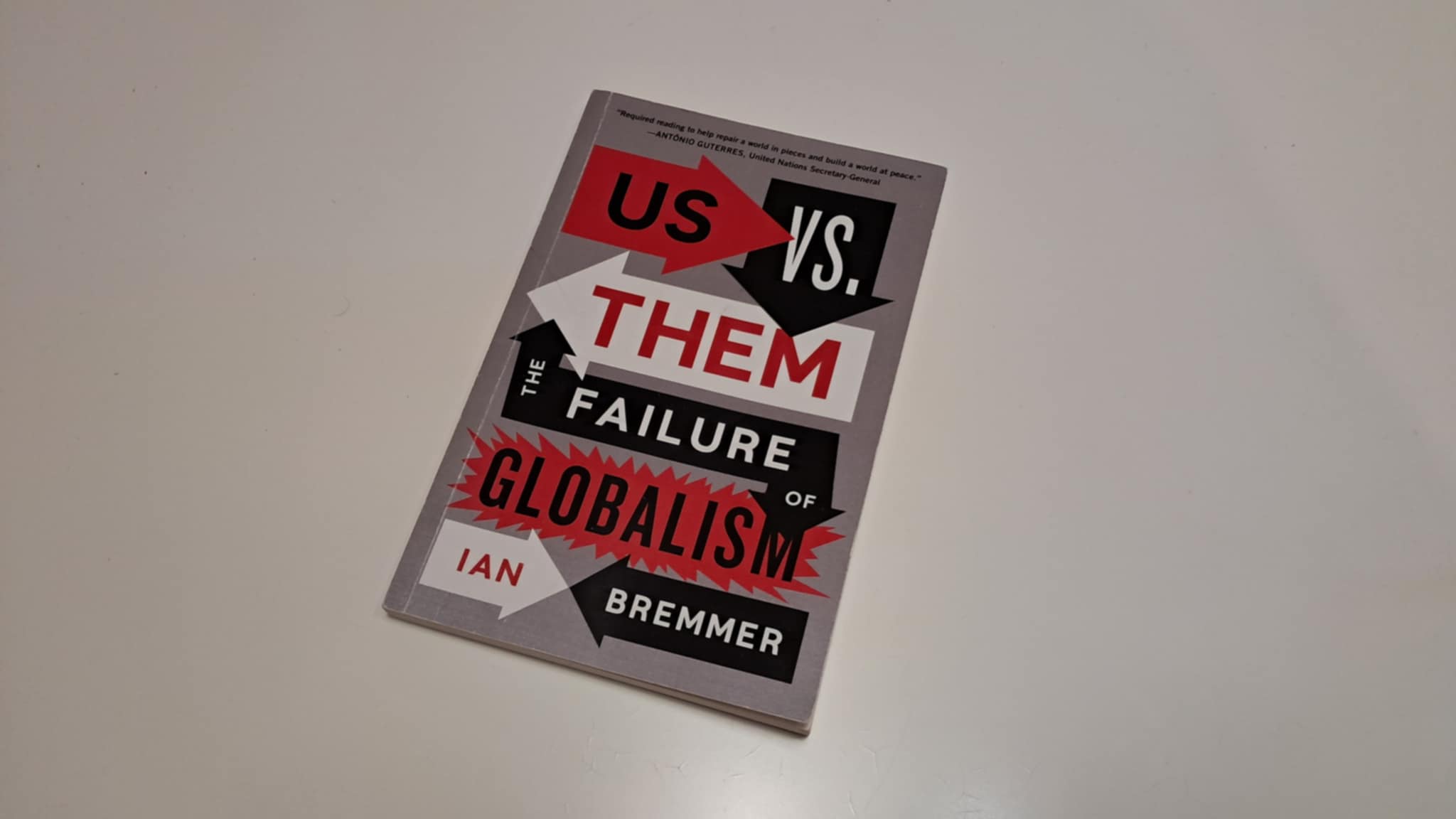
“Spin the camera toward the furious crowd—there’s the real story. It’s not the messenger that drives this movement. It’s the fears, often, if not always, justified—of ordinary people—fears of lost jobs, surging waves of strangers, vanishing national identities, and the incomprehensible public violence associated with terrorism. It’s the growing doubt among citizens that government can protect them, provide them with opportunities for a better life, and help them remain masters of their fate” (p. 8).
In Us vs. Them: The Failure of Globalism (2018), Ian Bremmer examines the populist ruptures that have unsettled political systems around the world in recent years. He argues that economic and cultural transformations over the past generation have created new social and political fault lines that democratic institutions have been unable or unwilling to manage. The resulting politics of division—between globalists and nationalists, urban centers and left-behind regions, and insiders and those who feel marginalized—have reshaped electoral landscapes and intensified the challenges facing contemporary governance across the world.
This review examines Bremmer’s argument, evaluates it considering later developments, and situates the book within broader debates on populism, inequality, and democratic resilience. It considers how the social, economic, and technological changes Bremmer identifies have continued to shape public attitudes and political outcomes across the world.
Globalism: Technocratic Consensus and Its Blind Spots
Bremmer portrays the post-Cold War globalist project as a framework that was primarily designed by technocratic elites rather than derived from broad democratic consensus. It relied on a Fukuyama-inspired ideology particularly among policymakers and business leaders that trade and technological progress were unambiguously beneficial for all parties involved. As he writes, globalists “insist that trade creates jobs without admitting that it can kill jobs as well” (p. 18).
The failure of social, political, and business elites to acknowledge the hardships created by globalism further widened the gulf between them and many ordinary citizens. Bremmer writes, “The pessimistic majority suspects that those with power, money, and influence care more about their cosmopolitan world than they do about fellow citizens.” Moreover, neglect by those who benefit from globalism “confirms the suspicions of those losing their sense of security and standard of living that elites living in New York and Paris have more in common with elites in Rome and San Francisco than with their discarded countrymen in Tulsa, Turin, Tuscaloosa, and Toulon” (pp. 8, 9).
Bremmer thus frames globalism as a system that may increase total prosperity but also produces widening inequality and profound cultural and economic dislocation. In this sense, “globalism contains the seeds of its own destruction: Even as it makes the world better, it breeds economic and cultural insecurity, and when people act out of fear, bad things happen” (p. 14).
Populism: The Social Dynamics Behind Its Rise
At the heart of Bremmer’s argument is the claim that contemporary populism emerges from anxieties that are often (but not always) legitimate. “Workers everywhere fear lost jobs and wages as a shifting global economy and technological change leave them behind,” he writes. Moreover, as globalism creates freer movement of people and increased migration, people worry about the ramifications of the “surging waves of strangers who alter the face and voice of the country they know.” As their anxieties grow, and they feel ignored by the elites who created the situation and “the government [that] cannot or will not protect them,” they grow angrier (p. 2). And when institutional channels fail or are not perceived as legitimate, many voters begin to throw metaphorical rocks at the system. Enter populism.
Populist leaders rise not necessarily by offering coherent policies but by feeding on public anger toward the system. Unlike the technocrats and elites who are perceived as self-serving or out of touch, populists resonate with people who believe that globalism has failed them. “They tell citizens they’ve been cheated of their chance to succeed, and that the media is in on it. They promise to comfort the afflicted, afflict the comfortable, and burn down the houses of power” (p. 2).
Further undermining social cohesion, populists offer “a compelling vision of division, of ‘us vs. them,’ of the worthy citizen fighting for his rights against the entitled or grasping thief” (p. 2). Depending on the context, “them” could be any number of groups—rich or poor, foreigners or minorities, people in an opposing political party or living in a different party of the country, or even people working in different professions. Thus, political identity becomes reshaped around divisions borne of social and economic grievances.
Technology as a Political Destabilizer
In Bremmer’s analysis, technological change is a driver of economic, social, and political transformation. Advances in automation threaten to eliminate large numbers of mid-skilled jobs, thus displacing millions of workers, especially in developing countries whose educational systems and institutions are least equipped to adapt. A country’s future trajectory, he suggests, will depend on its ability to recognize and address the challenges of these rapid changes.
Cyberspace is another point of vulnerability because cyberattacks are cheap to conduct, difficult to attribute, and can be very disruptive. At the same time, the informational sphere has become increasingly easy to pollute with fake news and manufactured narratives. Democratic states struggle to safeguard electoral integrity, while authoritarian and semi-authoritarian regimes use digital tools to surveil, censor, and manipulate public opinion. These pressures push governments to build virtual walls, such as censorship, digital protectionism, and restrictions on information flows.
The American Case: Populism as Symptom, Not Cause
Bremmer devotes significant attention to the United States as an example of institutional decline. He cites structural failures in education, infrastructure, the health-care system, trade policy, and foreign policy as sources of popular anger, arguing that these failures belong to the entire political establishment. “Citizens feel lied to or ignored—by politicians, the mainstream media, the business elite, bankers, and public intellectuals. They believe the game is rigged in someone else’s favor, and they have a point” (p. 162).
Trumpism, in his view, is not the source of America’s polarization, but its outcome. “No one voted for Donald Trump because he believed the United States was growing more secure and more prosperous,” he writes. “It’s easy to find fault with populists like Trump. He’s obnoxious, dishonest, and incompetent. But Donald Trump didn’t create us vs. them. Us vs. them created Donald Trump” (p. 161).
Mocking or denigrating Trump’s supporters instead of addressing their legitimate concerns only deepens the divides that populists exploit. “It is easier to mock Donald Trump, rail at his excesses, and caricature his backers than to work toward solutions to the problems that leave many convinced they have no future and that their fellow Americans don’t care” (p. 164). After all, Bremmer writes empathetically, “It’s hard to imagine what sort of future Americans can expect if the fate of these people is ignored” (p. 161).
Trump has not been the remedy to American ills, however, and the damage he has caused is serious. “He has further poisoned the attitudes of his followers toward government and the media, inflicted lasting damage on U.S. ties with close allies, and embarrassed the country before the world. Worst of all, he has deliberately pitted Americans against one another for political gain” (p. 163). Considering the increasingly toxic nature of the electoral process and the large numbers of Americans who do not participate, he fears that “American democracy itself is eroding” (p. 162).
The European Case: Elite-Citizen Detachment
Europe features prominently as an example of institutional overreach and elite detachment from the needs of everyday citizens. Bremmer argues that “the European Commission and the unelected bureaucrats who enforce its rules have legislated for its twenty-eight member nations without understanding their varied needs” (p. 9). Despite the sacrifices they’ve demanded of Europeans in the name of fiscal responsibility, “they’ve failed to halt a debt crisis that forced many Europeans to accept lower wages, higher prices, later retirement, less generous pensions, and an uncertain future, all while telling them they must bail out foreign countries that have spent their way into debt.” In their handling of the refugee and migrant crisis, “globalist European leaders insisted that all EU members must accept Muslim refugees in numbers determined in Brussels.” In regions where these policies were unpopular. or perceived as undemocratic demands imposed by out-of-touch (and often foreign) elites, “barricades and a spike in nationalism were the result” (p. 10). Europe is thus a microcosm of the broader tensions at the heart of globalism, namely the mismatch between supranational governance and domestic political legitimacy.
A Global Populist Turn: Beyond the West
Bremmer’s analysis extends into a comparative survey of China, India, Indonesia, Russia, Turkey, Brazil, Mexico, Venezuela, Nigeria, Saudi Arabia, Egypt, and South Africa (pp. 57-98). In these states, populism can be a top-down instrument of regime consolidation or an expression of bottom-up discontent. The common thread among these cases is institutional fragility. Social safety nets are weak, inequality is acute, and governments often lack the administrative capacity to mitigate disruptions. Bremmer predicts that the uneven diffusion of technological capabilities will only exacerbate inequality and increase political volatility.
Emerging middle classes, created by earlier periods of growth in these developing states, now have higher expectations and more demands of their governments. “Some of these governments will have the foresight, money, and talent they need to prepare young people to adapt to rapid technological change. Others won’t have the money or political will to act. Still others won’t recognize the scale of the challenge. These are the factors that will determine which of these countries can survive and thrive” (p. 97). Governments unable to meet their citizens’ expectations may resort to nationalist rhetoric, repression, and digital control.
Competing Futures: More Walls or a New Social Contract
Bremmer frames the future as a struggle between two trajectories. The first is one of building walls, by which he means not only physical infrastructure, but also protectionist barriers, tighter migration controls, censorship systems, and other tools designed to limit exposure to global volatility. These measures offer governments quick, visible responses to uncertainty, and they often resonate with citizens unsettled by rapid change. Yet he argues that this defensive logic may weaken long-term resilience by constricting economic growth and aggravating social tensions, thus creating a self-reinforcing cycle in which economic slowdowns divide voters and fuel more populist backlashes.
The second path is a fundamental rethinking of the social contract. “Faced with the challenges to come, there are things that (some) governments can do to rebuild relationships with their citizens. In short, they can rewrite the social contract to provide for the needs of society in new ways” (p. 139). Examples of measures that may improve people’s lives and thus state-society relations include tax reforms, improved social insurance, educational investment, incentives for part-time and gig employment, and even universal basic income. Although more difficult, “remaking the relationship between citizens and government is much more likely than the construction of walls to create lasting security and prosperity for the greatest number of people” (p. 167).
Such far-reaching political reforms, although ultimately better for governments and society alike, are in Bremmer’s estimation unlikely in the near term. “The sense of crisis isn’t yet strong enough, because so many globalists continue to profit from the system as it is, and walls of various kinds will protect them, temporarily, from real danger. Things have to become much worse, particularly for the winners, before they can become better for everyone else. This,” he concludes, “is the ultimate failure of globalism” (p. 166).
Bremmer ends with a message of vague hope and a call to action. “History and personal experience show that people give their best when the best is required of them…. Human beings use their natural ingenuity to create the tools they need to survive. In this case, survival requires that we invent new ways to live together.” To create a renewed sense of solidarity and counter the logic of us vs. them, “Necessity must again become the mother of invention” (p. 167).
Us vs. Them Revisited: Evaluating Bremmer’s Thesis amid Recent Events
Developments since the publication of Us vs. Them in 2018 reinforce Bremmer’s argument that the divide between perceived insiders and outsiders continues to shape politics. In many democracies, parties that campaign on anti-elite, anti-immigration, or anti-globalist themes have expanded their influence. Disruptions from the COVID pandemic and the subsequent rise in the cost of living have also reshaped political expectations and strengthened the appeal of leaders who present themselves as challengers to the status quo.
In the United States, the 2024 election revealed increasing polarization as voters across demographic groups supported candidates who promised to disrupt established political and economic structures. The Biden administration had intensified perceptions of the Democratic party as out-of-touch and elitist with its unpopular handling of immigration at the Mexico-US border and its tone deafness about inflation and the rising cost of living, which it dismissed as “transitory.” These dynamics contributed to strong Republican gains, particularly in competitive states where voters expressed frustration with economic insecurity, lack of border security and enforcement, and federal leadership they perceived as unresponsive.
In the 2025 elections, however, Democrats outperformed their 2024 results, even in heavily Republican districts. The shift may not represent growing support for the Democrats, but rather increasing dissatisfaction with the current administration and its policy priorities, which many voters perceive as putting the Trump administration on the wrong side of the us-vs.-them divide.
Similar patterns have appeared across Europe as populist and anti-establishment parties increased their vote shares in recent national elections. The rise of Brothers of Italy and the Sweden Democrats reflects this broader trend, as do electoral gains for Marine LePen’s National Rally (RN) in France and Alternative for Germany (AfD) in Germany. Slovakia and Czechia show comparable dynamics, with the electoral successes of Smer-SD in Slovakia and ANO in Czechia signaling continued public dissatisfaction with mainstream leadership. Likewise, the 2024 European Parliament elections brought a large number of populist parties into formal representation across the continent. These developments indicate that the social and economic grievances Bremmer identified remain largely unresolved.
Technological disruption has also continued in ways that closely match Bremmer’s expectations. The rapid spread of generative AI has intensified concerns about job displacement in manufacturing, logistics, and administrative work, and it has widened skill gaps in countries that lack strong training systems. In the United States, companies such as Amazon and JPMorgan Chase have accelerated AI adoption, while governments in Europe are exploring national reskilling programs to prepare workers for increased automation in industrial sectors. In Asia, China and India are implementing large-scale AI and digital literacy initiatives to address skill shortages and mitigate the social impact of automation.
Cyberspace has become even more contested (as described also by Anne Applebaum). State-linked actors such as those associated with Russia, China, and Iran have carried out frequent cyberattacks, targeting critical infrastructure such as power grids, healthcare systems, and financial networks. Digital manipulation has become routine in geopolitical competition, as seen in the use of disinformation campaigns during elections in the United States, Germany, and Brazil. Democratic governments continue to struggle with misinformation circulating on major platforms like Facebook and X, and its effects on electoral legitimacy remain a challenge.
The construction of the various geopolitical walls described by Bremmer—economic decoupling, protectionism, technological insulation, migration restrictions, and censorship—has become increasingly evident. To encourage supply-chain reshoring and domestic industrial development, Japan and South Korea have invested in battery and semiconductor production, India has promoted local manufacturing of electronics and pharmaceuticals, Australia and Canada have expanded programs for critical mineral extraction and clean-tech supply chains, and the United States has imposed tariffs. Many countries have also adopted stricter migration controls, including higher asylum thresholds in Hungary and Poland, accelerated deportation procedures in the United States, and new border monitoring technologies across the EU. Governments in China, Russia, and Turkey have strengthened censorship and increased digital surveillance, while democracies including the United States, Germany, and Australia have introduced new restrictions on data flows and foreign technology platforms.
The alternative path Bremmer suggests, which centers on rethinking and reinvigorating the social contract, has gained rhetorical prominence but remains limited in practice. Some governments have experimented with expanded welfare programs, new forms of worker assistance, and mandatory military service, yet few have pursued the kind of systemic reforms Bremmer envisioned. The gap between policy ambitions and political feasibility remains substantial, reinforcing his argument that meaningful reform is unlikely until the pressures on existing systems grow more severe.
Conclusion: Us vs. Them in a Shifting Global Order
Bremmer’s Us vs. Them continues to resonate because the political and social fractures he identified—the divide between insiders and outsiders, the erosion of trust in institutions, and the appeal of populist narratives—remain central in global politics. Since the book’s publication in 2018, developments in the United States, Europe, and emerging economies support his argument that political stability depends on a state’s capacity and willingness to manage the social and economic costs of globalization and technological change. If governments succeed, the current period of fragmentation may give way to a more resilient, stable global order. If they fail, a fractured world defined by walls and distrust will become increasingly difficult to avoid.
Us vs. Them provides a practical framework for understanding the forces reshaping the global order. Bremmer examines the risks posed by populism, inequality, and technological disruption, while also challenging readers to consider how governments might rebuild trust and social cohesion. His work is valuable for anyone examining democratic resilience and the evolving global landscape, and it complements works by Anne Applebaum, Peter Zeihan, and other leading geopolitical analysts.