With the current conflict in the Middle East, Iran’s nuclear program has again moved to the center of international debate. Why does a country so rich in hydrocarbon resources need a nuclear program? Explanations typically emphasize deterrence, bargaining leverage, regime prestige, and ideological defiance. Each of these factors has analytical weight, but they often miss a more structural consideration rooted in geography.
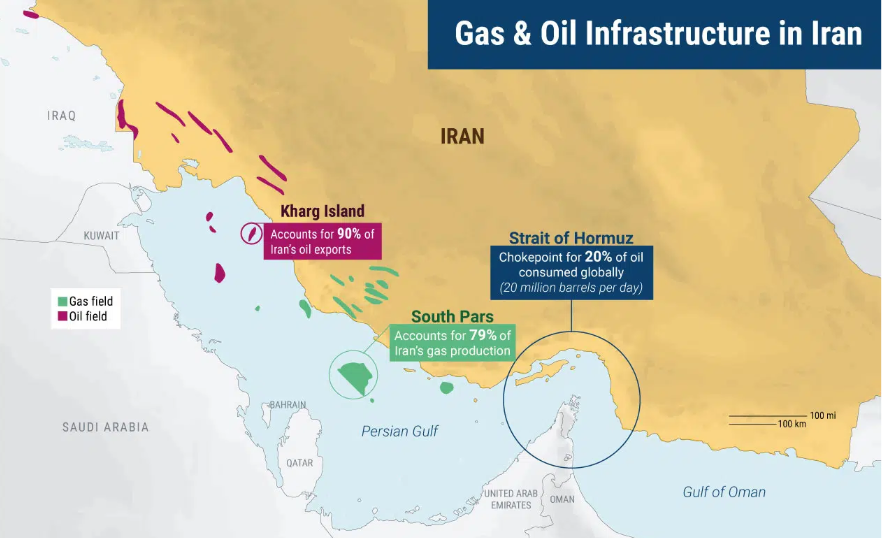
Iran is a resource-rich state, but its most valuable hydrocarbon assets lie in strategically exposed terrain near borders and maritime chokepoints. Nuclear energy offers the country a way to reduce reliance on vulnerable oil and gas infrastructure. Thus, Iran’s nuclear strategy can be interpreted not merely as geopolitical signaling, but also as an effort to mitigate geographic vulnerability.
[This article does not argue for an Iranian-controlled nuclear program or defend the Iranian regime. Rather, it highlights an underreported reason why the country may seek civilian nuclear infrastructure. By recognizing Iran’s legitimate energy security concerns, the international community can more effectively distinguish and challenge Iranian policies that exceed those concerns.]
Iran’s Nuclear Program: Energy Geography and Strategic Exposure
Iran’s hydrocarbon wealth is heavily concentrated in the southwest, particularly in the province of Khuzestan, near the Iraqi border and the northern shore of the Persian Gulf (see Figure 1). This region contains some of the country’s largest oil fields, including those that anchor Iran’s export capacity, and accounted for around 88 percent of Iran’s total crude oil production capacity in 2019. Major gas reserves, such as the offshore South Pars field, are likewise located along the Gulf. These resources are economically valuable, but their geographic position creates strategic exposure.
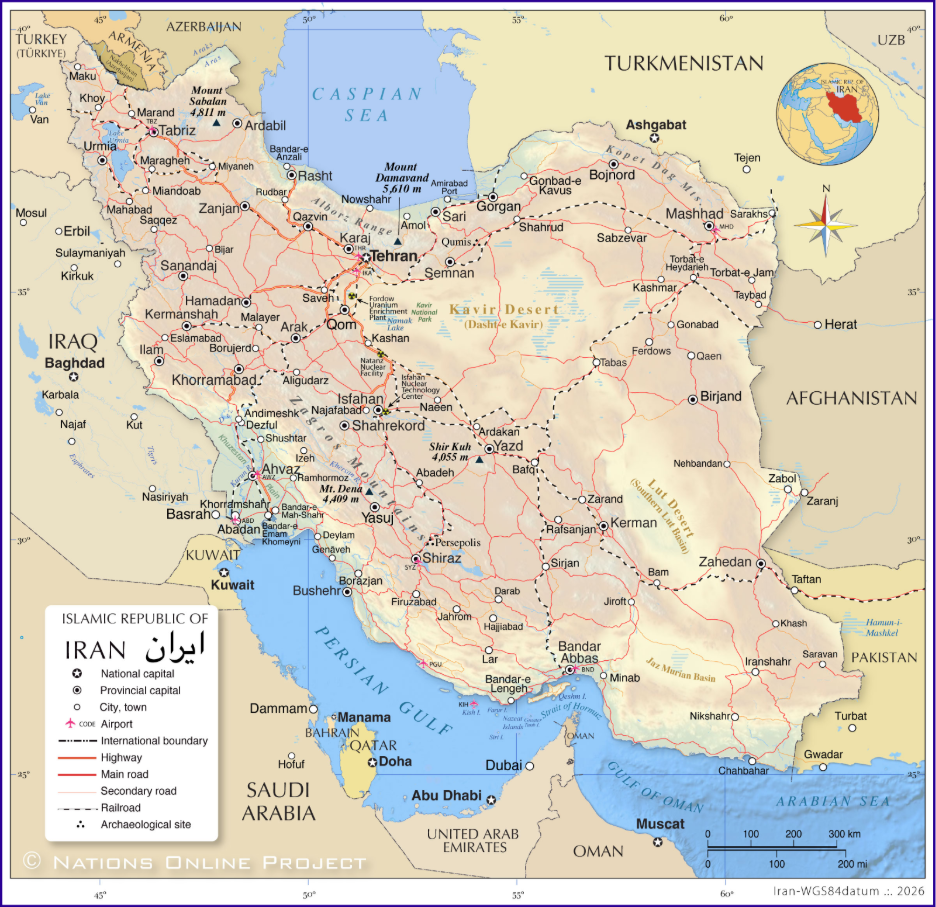
By contrast, Iran’s core population centers sit deeper inland, shielded in part by the Zagros Mountains, which stretch along the western edge of the Iranian plateau and have historically functioned as a defensive barrier against invasion (see Figure 2). Thus, whereas the population heartland lies behind natural fortifications, the country’s energy resources lie in lowland terrain near international borders and maritime chokepoints.
In the event of conflict, crucial oil infrastructure becomes an obvious target. Energy installations are fixed, visible, and difficult to conceal. Fields can be overrun, pipelines disrupted, refineries bombed, and export terminals blockaded. A state dependent on exposed hydrocarbon resources faces the risk of physical seizure, economic strangulation, and a sharp reduction in domestic energy supply.
Historical Precedent: The Iran-Iraq War
This vulnerability is not hypothetical. During the Iran–Iraq War in the 1980s, both sides targeted oil facilities and shipping in what became known as the Tanker War. Attacks on refineries, pipelines, and tankers were intended to degrade the enemy’s economic capacity as well as its military strength. As much of the fighting occurred in or near Khuzestan, the very province that houses key oil fields, the war underscored for Iran how concentrated and externally accessible its energy infrastructure was. Like present-day Ukrainian strikes against Russian infrastructure, the conflict demonstrated that vulnerable hydrocarbon production can be disrupted with relative ease in wartime, undermining the state’s economic and military base.
Nuclear Energy as Strategic Redundancy
Within this context, Iran’s pursuit of civilian nuclear energy takes on a different strategic dimension. No form of energy production is invulnerable, but nuclear power would diversify the country’s energy mix and offer advantages over a domestic energy system reliant on hydrocarbons.
Iran has consistently maintained that its nuclear program is intended for peaceful energy production. Critics question this claim, pointing to enrichment activities and dual-use capabilities. Yet even within a strictly civilian framework, nuclear power would provide security and strategic redundancy. By reducing reliance on oil and gas for domestic electricity generation, Iran could increase hydrocarbon exports and cushion the impact of potential disruptions.
In wartime, a reactor complex positioned inland may be harder to seize than sprawling oil fields along a contested border. For a country that endured eight years of traumatic war of attrition with Iraq, energy diversification is not purely economic policy–it is national security policy.
The Strait of Hormuz and the Chokepoint Problem
Iran’s export model also depends heavily on maritime routes through the Strait of Hormuz, one of the world’s most critical energy chokepoints. Any conflict that escalates in the Gulf risks disrupting shipping, whether through blockade, mining, or naval confrontation. Although Iran possesses capabilities in the region, it is nevertheless vulnerable to interruption of its own exports.
Nuclear energy, by contrast, is consumed domestically and does not rely on daily tanker traffic through contested waters. Once fuel is secured and reactors are operational, electricity production becomes less immediately dependent on vulnerable sea lanes. From a resilience perspective, this reduces exposure to maritime coercion and creates internal energy stability less tied to the volatility of export routes.
Conclusion: Iran’s Nuclear Program and Energy Security
Iran’s nuclear ambitions are best understood as multidimensional, as geography imposes structural realities that ideology alone cannot explain. Concentrated hydrocarbon reserves near exposed borders create enduring vulnerabilities, and the country’s memory of wartime targeting reinforces those concerns. Nuclear energy, although controversial, costly, and politically fraught, offers a form of strategic insurance.
For an Iranian state shaped by revolution, invasion, and prolonged conflict, energy diversification is not merely economic rationality. It is a response to constraints imposed by geography itself. It is a long-term strategic attempt to ensure that, should Iran’s southwestern region become contested again, the lights in Tehran will not go out. And no matter who governs in Tehran, these concerns will remain.
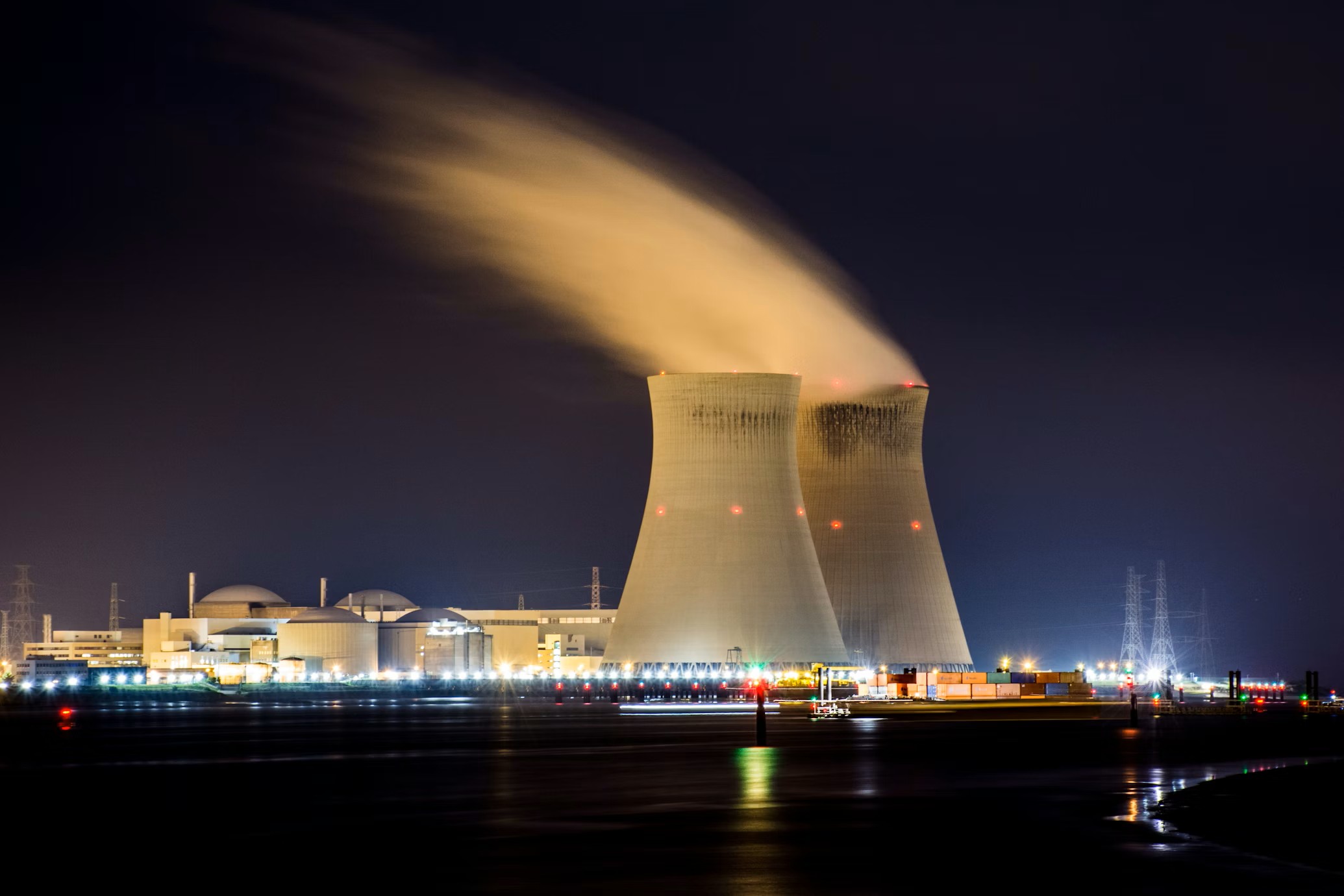
Featured image by Nicolas HIPPERT on Unsplash
For more about geopolitics and the changing world order, please see my reviews of works by Anne Applebaum, Ian Bremmer, and Peter Zeihan.
Leave a Reply