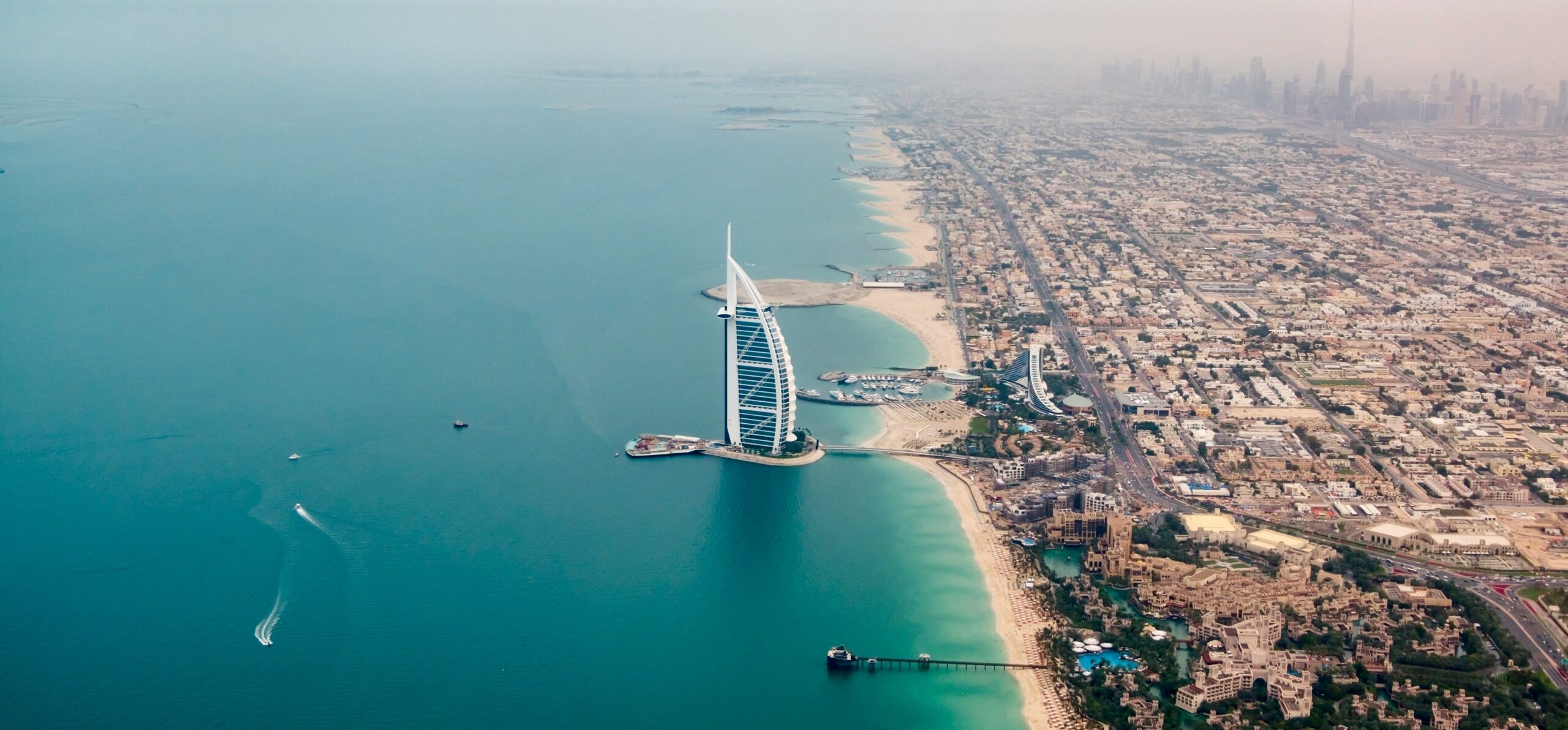
For decades, several Gulf states cultivated reputations as safe havens in a volatile region. The United Arab Emirates, Qatar, and Saudi Arabia positioned themselves as global hubs for finance, logistics, tourism, and expatriate life. Their success depended on the assumption that regional conflict could be contained at a distance.
That assumption has now broken down.
The war involving Iran, the United States, and Israel has expanded beyond contained fronts and into the wider Gulf. Missile and drone strikes have reached critical infrastructure, urban environments, and economic systems once considered insulated. This is not a gradual erosion of confidence—it is a sudden rupture. The idea of the Gulf as a safe haven has been challenged by the arrival of war.
Gulf States, War, and Risk: From Insulation to Exposure
The defining shift is not simply that regional conflict exists, but that it has crossed into spaces once believed to be removed from it. Gulf states built their model on integration into global systems while maintaining distance from regional instability. That balance no longer holds. Infrastructure that once symbolized connectivity now represents exposure and vulnerability. Ports, airports, financial centers, and energy facilities are no longer just economic assets—they are potential targets.
This transformation alters the strategic identity of the region. Gulf states are no longer peripheral to conflict. Rather, in the Iran war, they are embedded within it.
Logistics Under Fire
The Gulf has long functioned as a central artery of global trade, linking continents through highly efficient logistics networks. War has disrupted that function immediately, as Iran’s closure of the Strait of Hormuz demonstrates. Shipping routes have become uncertain as risk calculations change.
Insurance costs haven risen sharply, reflecting not hypothetical danger but active threats. Maritime and aviation providers have cancelled war-risk coverage for vessels operating in the Gulf and war-risk premiums have surged by as much as 200 to 300 percent, dramatically increasing the cost of moving energy through critical routes such as the Strait of Hormuz. This repricing reflects not perception alone but quantified assessment of danger.
When a system heavily dependent on predictability and reliability is disrupted, the adjustment is abrupt. Logistics and trade flows do not wait for stability to return—they seek alternatives. Companies begin to reroute goods, not as a precaution, but as a necessity. Over time, even temporary rerouting can produce lasting structural change, weakening the previous dominance of established hubs like the Gulf.
Energy and Economic Vulnerability
Energy infrastructure sits at the center of the conflict. Facilities that underpin global supply have been targeted, drawing the Gulf directly into the strategic logic of the war. This creates a cycle in which economic assets become military objectives, and each strike increases the likelihood of escalation.
The Gulf’s role as a stable energy provider has long been a cornerstone of the global economy. That role now carries greater uncertainty. Markets respond not only to actual disruption but to the possibility of further strikes, amplifying volatility and extending the economic impact beyond the region itself.
Finance in a War Environment
Financial systems depend on predictability, and war removes it instantly. Capital reacts quickly to uncertainty. Investment decisions are delayed or redirected, and risk premiums rise as markets reassess exposure. The Gulf’s position as a neutral repository for wealth thus becomes more difficult to sustain when it is directly affected by conflict, with analysts noting that escalating regional strikes have already prompted investors to reassess exposure to Gulf financial centers amid heightened geopolitical risk.
Even if financial institutions continue to operate, their character changes. They are no longer perceived as insulated environments but as systems tied to the dynamics of an active war. This shift alters behavior at every level, from large institutional investors to individual asset holders.
Real Estate and the Decline of Permanence
Real estate markets in the Gulf have long been built on the assumption of long-term stability. Urban development and grandiose building projects like the Burj Khalifa have served as physical expressions of confidence in the future, with Dubai’s skyline itself described as a “story of vision, resilience, and progress” underpinning investor trust and long-term growth expectations. War disrupts that assumption immediately.
When infrastructure is threatened or damaged, property is no longer understood as a secure store of value. Investors begin to reassess not just price but also risk. Recent data from Dubai’s real estate market shows a sharp drop in transactions and renewed price sensitivity following missile strikes and regional escalation, with some properties already being discounted amid falling confidence in the stability of the Gulf investment environment. Properties that were once a symbol of prestige and permanence have become more contingent and uncertain.
Human Capital in Motion
The Gulf’s economic model relies heavily on expatriate labor across all sectors, with foreign workers forming the majority of the workforce in many Gulf Cooperation Council economies. In a slow crisis, human capital tends to shift gradually, but war compresses that timeline. Decisions that might once have taken months or years are made in days, as seen when airlines began rapidly adjusting schedules following regional missile and drone strikes, triggering immediate uncertainty for foreign residents and workers.
As conditions deteriorate, foreign nationals begin to reconsider their presence in the region. Governments issue advisories and, in some cases, begin organized withdrawals or emergency relocation planning. The result is not a slow hollowing out but a sudden disruption in labor markets. This effect is particularly pronounced in high-skill sectors, where mobility is greatest and professionals in finance, engineering, and technology are quickest to respond to rising instability.
Air Travel, Tourism, and Connectivity
The Gulf’s role as a global aviation hub depends on reliable and uninterrupted connectivity. War challenges that foundation directly as airspaces become contested, routes are altered, and costs increase. Airports themselves carry new risks as highly visible and strategically significant locations, as seen when Dubai International Airport was forced to suspend operations following missile and drone threats, with passengers sent to shelters and flights halted during active attacks.
Tourism, like transport hubs, depends on the perception of safety. Active conflict removes that perception instantly and, unlike other areas, tourism does not adapt gradually. It responds immediately to changes in perceived risk, as events are cancelled and visitors reconsider plans. The economic consequences are therefore rapid and visible, for example with vacation rental cancellations in the UAE more than doubling within days of the initial strikes.
Digital Infrastructure and New Frontlines
The Gulf has emerged as a major center for digital infrastructure, including data storage and cloud services. War extends into this domain as well, as cyber operations and attacks on digital systems introduce a new layer of vulnerability. Economic activity increasingly depends on infrastructure that can be disrupted without physical destruction, or in some cases through precisely targeted strikes that disable services without widespread visible damage.
This adds complexity to an already strained environment, as even limited attacks on data infrastructure can cascade across financial systems, logistics networks, and communication platforms, amplifying the broader effects of conflict. For example, Iranian drone strikes hit multiple Amazon Web Services data centers in the United Arab Emirates and Bahrain, causing outages that disrupted banking, enterprise software, and cloud-dependent services across the region.
Military Reality and Strategic Exposure
Gulf states have long relied on a combination of internal security and external partnerships, particularly the presence of U.S. military bases intended to provide deterrence. In the current context, however, this also creates exposure, as facilities linked to external powers become part of the conflict landscape. This was made explicit when Iranian missile strikes targeted U.S. military installations across the Gulf, including bases in Qatar, Bahrain, Kuwait, and the United Arab Emirates.
This dynamic complicates strategic calculations. Integration into global security frameworks offers protection, but it also ties local stability to broader geopolitical confrontation, with analysts noting that Gulf states are increasingly being targeted because of their security ties to the United States. The distinction between shield and liability becomes less clear.
Political Constraints and Alignment
The expansion of conflict reduces the space for neutrality. Gulf states have historically balanced relationships across competing powers, maintaining diplomatic, economic, and security ties with both the United States and Iran. War forces clearer positioning, and that flexibility is now eroding, as analysts note that Gulf states are “caught in the crossfire” and facing increasing pressure to move beyond neutral postures as attacks escalate across the region.
At the same time, domestic considerations become more complex. Governments must manage both internal stability and external expectations in an environment where uncertainty is high and rapidly evolving. Policymakers now face rising internal pressures linked to economic disruption, security fears, and potential fragmentation within the Gulf Cooperation Council, all while responding to competing demands from external partners such as the United States. The result is a compressed decision-making environment in which external conflict and internal stability are increasingly intertwined.
The Psychological Break
Perhaps the most significant shift is psychological. The Gulf’s stability rested on a widely shared belief that, despite regional tensions, it would remain insulated from direct conflict, a perception long reinforced by its role as a safe haven for investment, labor, and global business activity. That belief has now been challenged, as recent escalations have prompted investors to reassess regional exposure and question assumptions of insulation even in traditionally stable Gulf financial centers. This does not necessarily produce collapse, but it does produce rapid reconfiguration.
Conclusion: Rethinking Stability and the Safe Haven Model
The Gulf is not disintegrating, but it is being transformed. The conditions that supported its role as a global safe haven have been altered by the arrival of war within its own space.
This transformation has implications far beyond the region. Energy markets, trade networks, and financial flows are all affected by the shift. The Gulf remains deeply integrated into global systems, but that integration now carries greater risk.
The idea of the safe haven has not disappeared, but it has been redefined. Given the global challenges, stability in the Gulf and elsewhere can no longer be understood as distance from conflict. It must be understood as the capacity to operate within it.